logo
Henan Ruiyao Intelligent Environmental Protection Co., Ltd
Products
Products
Home > Products > Roller Kiln > High-Temperature Atmosphere Sealed Roller Hearth Kiln for Electronic Ceramic Components

High-Temperature Atmosphere Sealed Roller Hearth Kiln for Electronic Ceramic Components

Product Details

Place of Origin: CHINA

Brand Name: RUIYAO

Payment & Shipping Terms

Minimum Order Quantity: 1

Price: RMB 100,0000-150,0000 yuan

Packaging Details: According to customers needs

Delivery Time: 45 days

Payment Terms: L/C,, D/A,, D/P, T/T, Western Union,

Supply Ability: 45 days

Get Best Price
Highlight:

High-temperature roller kiln for ceramics

,

Sealed roller hearth kiln

,

Electronic ceramic components kiln

Gas Power:
30-100 Kcal
Roller Speed:
Adjustable
Productname:
Roller Kiln
Core Components:
PLC, Motor, Pump
Firing Atmosphere:
Oxidizing/ Reducing/ Inert
Heating Rate:
10-30℃/min
Unit Length:
Customizable
Energyefficiency:
High
Working Temperature:
Customized
Materialprocessed:
Ceramics, Refractories, Minerals
Type:
Continuous Kiln
Heating Method:
Electric/Gas
Loading Pattern:
4 Columns With Single Layer
Kiln Width:
Customized
Product Type:
Continuous Kiln
Gas Power:
30-100 Kcal
Roller Speed:
Adjustable
Productname:
Roller Kiln
Core Components:
PLC, Motor, Pump
Firing Atmosphere:
Oxidizing/ Reducing/ Inert
Heating Rate:
10-30℃/min
Unit Length:
Customizable
Energyefficiency:
High
Working Temperature:
Customized
Materialprocessed:
Ceramics, Refractories, Minerals
Type:
Continuous Kiln
Heating Method:
Electric/Gas
Loading Pattern:
4 Columns With Single Layer
Kiln Width:
Customized
Product Type:
Continuous Kiln
High-Temperature Atmosphere Sealed Roller Hearth Kiln for Electronic Ceramic Components

High-Temperature Atmosphere Sealed Roller Hearth Kiln for Electronic Ceramic Components

Brief Description

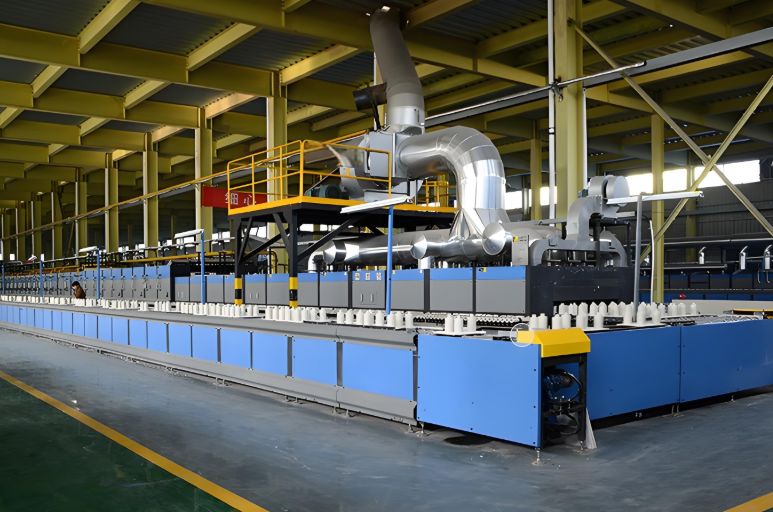
The High-Temperature Atmosphere Sealed Roller Hearth Kiln for Electronic Ceramic Components is designed for controlled thermal processing of advanced ceramic materials and electronic ceramic components. The kiln combines a roller hearth conveying system with a sealed furnace structure, providing stable material transfer and a controlled firing atmosphere throughout the heating process. Its multi-zone temperature control system allows different heating, soaking, and cooling stages to be managed according to the material characteristics and firing schedule. The sealed design helps reduce unwanted air infiltration and supports atmosphere-sensitive processes where precise control of oxygen conditions is required. Continuous roller conveying is suitable for high-throughput production and can improve consistency between batches. The kiln can be configured according to component dimensions, firing temperature, atmosphere requirements, production capacity, and process cycle, making it suitable for industrial ceramic production lines requiring repeatable thermal processing and reliable long-term operation.

Key Features

1. High-Temperature Firing Capability
The kiln is engineered for high-temperature ceramic processing and can be configured according to the required firing temperature and material characteristics. Its refractory lining, heating elements or burners, and thermal insulation system are selected to withstand continuous high-temperature operation. Zoned heating enables the temperature profile to be adjusted throughout the kiln, supporting controlled heating, soaking, and cooling processes for electronic ceramic components.

2. Sealed Atmosphere Control
A sealed furnace structure helps minimize uncontrolled air infiltration during firing. The atmosphere system can be configured for different process requirements, including controlled oxidation or other specified furnace atmospheres. Adjustable atmosphere control improves process repeatability and helps protect sensitive ceramic materials from unwanted reactions caused by excessive oxygen or inconsistent furnace conditions.

3. Continuous Roller Hearth Conveying
The roller hearth system provides continuous and stable movement of ceramic components through the firing chamber. Compared with batch-type kiln operation, continuous conveying is well suited to automated production lines and high-volume manufacturing. Roller speed can be coordinated with the required firing cycle, while the conveying structure can be adapted to different component sizes, loading arrangements, and production requirements.

4. Precise Multi-Zone Temperature Control
Independent temperature zones allow the firing curve to be controlled according to the characteristics of electronic ceramic materials. Temperature monitoring and automatic control help maintain a stable thermal profile across the kiln. The system can integrate PLC-based control, temperature sensors, heating control, atmosphere monitoring, and alarm functions, providing operators with centralized management of the firing process.

High-Temperature Atmosphere Sealed Roller Hearth Kiln for Electronic Ceramic Components

Applications

1. Electronic Ceramic Components
The roller hearth kiln can be used for the high-temperature firing of various electronic ceramic components where controlled thermal treatment is required. Its continuous conveying system and multi-zone temperature control are suitable for industrial production environments requiring stable firing conditions and repeatable processing cycles.

2. Ceramic Substrates
Ceramic substrates used in electronic and electrical applications may require carefully controlled firing to achieve the desired material properties and dimensional stability. The kiln provides a controlled thermal profile and continuous conveying process, making it suitable for production lines processing ceramic substrates in different sizes and configurations.

3. Dielectric and Insulating Ceramic Materials
The kiln can be configured for firing ceramic materials used for electrical insulation and dielectric applications. Controlled temperature and atmosphere conditions help maintain consistent processing conditions throughout the firing cycle. The system can be customized according to material composition, component geometry, firing schedule, and production capacity.

4. Advanced Technical Ceramics
The equipment is also applicable to other advanced ceramic products requiring high-temperature thermal treatment. These may include precision ceramic parts, functional ceramics, and specialized ceramic components for electrical, electronic, and industrial applications. The roller hearth configuration supports continuous production and integration with upstream and downstream automation equipment.

FAQs

Q1: What types of electronic ceramic products can be fired in this roller hearth kiln?
The kiln can be configured for various electronic and technical ceramic products, including ceramic substrates, insulating components, dielectric ceramics, and other precision ceramic parts. The exact kiln configuration depends on the material composition, product dimensions, firing temperature, atmosphere, and required production capacity.

Q2: Why is atmosphere sealing important for electronic ceramic firing?
Atmosphere sealing helps reduce uncontrolled air infiltration and provides better control over the furnace environment. This is particularly important for materials whose firing behavior is sensitive to oxygen concentration or other atmospheric conditions. The appropriate atmosphere configuration should be determined according to the specific ceramic formulation and firing process.

Q3: Can the roller hearth kiln be integrated into an automatic production line?
Yes. The continuous roller conveying system can be integrated with loading, unloading, transfer, inspection, and other automated equipment. PLC and HMI control systems can also be configured for centralized monitoring of temperature, roller speed, atmosphere conditions, alarms, and other key operating parameters.

Q4: Can the kiln be customized for different electronic ceramic production requirements?
Yes. The kiln can be customized according to product dimensions, firing temperature, atmosphere requirements, production capacity, heating method, kiln length, roller arrangement, and firing cycle. A technical proposal can be developed after confirming the ceramic material, product specifications, hourly or daily output, and required firing curve.