logo
Henan Ruiyao Intelligent Environmental Protection Co., Ltd
Products
Products
Home > Products > Roller Kiln > Low Energy Consumption Continuous Roller Hearth Kiln for Architectural Porcelain Tiles

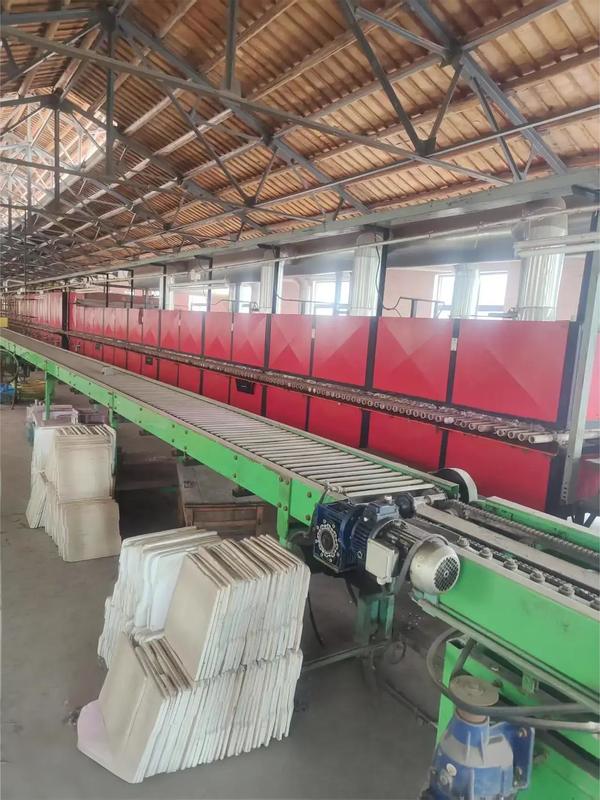
Low Energy Consumption Continuous Roller Hearth Kiln for Architectural Porcelain Tiles

Product Details

Place of Origin: CHINA

Brand Name: RUIYAO

Payment & Shipping Terms

Minimum Order Quantity: 1

Price: RMB 100,0000-150,0000 yuan

Packaging Details: According to customers needs

Delivery Time: 45 days

Payment Terms: L/C,, D/A,, D/P, T/T, Western Union,

Supply Ability: 45 days

Get Best Price
Highlight:

low energy consumption roller kiln

,

continuous roller hearth kiln

,

architectural porcelain tile kiln

Gas Power:
30-100 Kcal
Roller Speed:
Adjustable
Productname:
Roller Kiln
Core Components:
PLC, Motor, Pump
Firing Atmosphere:
Oxidizing/ Reducing/ Inert
Heating Rate:
10-30℃/min
Unit Length:
Customizable
Energyefficiency:
High
Working Temperature:
Customized
Materialprocessed:
Ceramics, Refractories, Minerals
Type:
Continuous Kiln
Heating Method:
Electric/Gas
Loading Pattern:
4 Columns With Single Layer
Kiln Width:
Customized
Product Type:
Continuous Kiln
Gas Power:
30-100 Kcal
Roller Speed:
Adjustable
Productname:
Roller Kiln
Core Components:
PLC, Motor, Pump
Firing Atmosphere:
Oxidizing/ Reducing/ Inert
Heating Rate:
10-30℃/min
Unit Length:
Customizable
Energyefficiency:
High
Working Temperature:
Customized
Materialprocessed:
Ceramics, Refractories, Minerals
Type:
Continuous Kiln
Heating Method:
Electric/Gas
Loading Pattern:
4 Columns With Single Layer
Kiln Width:
Customized
Product Type:
Continuous Kiln
Low Energy Consumption Continuous Roller Hearth Kiln for Architectural Porcelain Tiles

Low Energy Consumption Continuous Roller Hearth Kiln for Architectural Porcelain Tiles

Brief Description

The Low Energy Consumption Continuous Roller Hearth Kiln for Architectural Porcelain Tiles is an industrial firing system designed for continuous and stable production of porcelain tiles, architectural ceramics, and other high-temperature ceramic products. The kiln uses a roller hearth conveying system to move tiles smoothly through preheating, firing, and cooling zones without kiln cars. Its continuous operation supports high production capacity while maintaining consistent firing conditions. Independent temperature control in different kiln zones allows manufacturers to establish suitable heating and cooling curves according to tile body composition, thickness, glaze, and firing requirements. The kiln can be configured with efficient burners, optimized insulation, automatic temperature regulation, and PLC-based control. It is suitable for modern tile production lines where stable product quality, controlled energy consumption, and high automation are important. The roller hearth design also provides convenient integration with automatic loading, unloading, glazing, sorting, and packaging systems.

Key Features

1. Continuous Roller Hearth Conveying System
The kiln uses heat-resistant rollers to continuously transport porcelain tiles through the firing chamber. Compared with intermittent kiln operation, continuous conveying supports stable production flow and can be integrated with upstream and downstream automatic equipment. Roller spacing, conveying speed, and kiln dimensions can be configured according to product size, thickness, and production capacity.

2. Zoned Temperature Control
Multiple heating zones allow operators to control the temperature profile throughout the kiln. Independent regulation of preheating, firing, and cooling sections helps match the thermal curve to different porcelain tile formulations and firing requirements. Accurate temperature management contributes to uniform firing, stable dimensional performance, and consistent surface quality across the production batch.

3. Energy-Efficient Thermal Design
The kiln can incorporate high-performance refractory and insulation materials, optimized combustion arrangements, and controlled hot-air circulation to reduce unnecessary heat loss. The thermal structure is designed to maintain stable temperatures while limiting heat dissipation through the kiln walls and roof. Actual energy consumption depends on tile specifications, firing temperature, fuel type, kiln size, and operating conditions.

4. Automatic PLC Control and Monitoring
A PLC-based control system can coordinate temperature regulation, roller speed, burner operation, alarms, and other key operating parameters. The HMI provides operators with a centralized interface for monitoring kiln status and adjusting process settings. Automatic control reduces dependence on manual operation and helps maintain repeatable firing conditions during continuous production.

Low Energy Consumption Continuous Roller Hearth Kiln for Architectural Porcelain Tiles

Applications

1. Architectural Porcelain Tile Production
The roller hearth kiln is suitable for firing architectural porcelain tiles used for residential, commercial, and public building projects. Its continuous conveying system and multi-zone temperature control support stable firing of different tile formats and thicknesses. The kiln can be integrated with automatic tile handling and glazing equipment to form a complete porcelain tile production line.

2. Large-Format Porcelain Tiles
For large-format porcelain products, maintaining consistent temperature distribution and controlled conveying is important for reducing firing-related deformation and quality variation. A properly designed roller hearth kiln can provide a controlled thermal profile and stable roller movement. The final kiln configuration should be determined according to tile dimensions, thickness, body composition, firing temperature, and required production capacity.

3. Glazed Ceramic and Porcelain Tiles
The kiln can be applied to glazed tile production where controlled heating and cooling are required to achieve the specified surface and body properties. Temperature zones and firing parameters can be adjusted according to glaze characteristics and ceramic formulation. Integration with automatic glazing and material-handling equipment makes the system suitable for continuous industrial production.

4. Customized Ceramic Products
Beyond standard porcelain tiles, the roller hearth kiln can be configured for selected architectural ceramic products and specialty tile applications. Kiln length, effective width, roller arrangement, heating system, cooling system, and control configuration can be adapted to the production requirements. Before equipment selection, manufacturers should provide product dimensions, material composition, firing temperature, production capacity, and fuel type.

FAQs

Q1: What products can be fired in a roller hearth kiln?
A roller hearth kiln is commonly used for porcelain tiles, ceramic tiles, glazed tiles, and other flat ceramic products requiring continuous firing. The exact application depends on product dimensions, material composition, firing temperature, and thermal cycle.

Q2: Why use a roller hearth kiln for porcelain tile production?
The main advantages are continuous conveying, precise temperature control, high automation, and suitability for high-volume production. The roller system eliminates the need for conventional kiln cars and allows direct integration with automated production equipment.

Q3: How can the energy consumption of a roller hearth kiln be reduced?
Energy consumption can be controlled through optimized insulation, efficient burners, appropriate kiln zoning, effective heat recovery, accurate temperature control, and proper kiln operation. Actual consumption should be evaluated based on product specifications and the complete firing process rather than using a fixed value.

Q4: What information is required to design a roller hearth kiln?
Key information normally includes tile dimensions and thickness, raw material composition, product weight, required firing temperature, firing cycle, production capacity, fuel type, loading arrangement, and factory layout. These parameters are used to determine kiln dimensions, roller configuration, heating capacity, and control system.